Author: Mr. Jarreth, Director Technician at Decom Aircon. 25+ years of field experience servicing HDB, condo, and commercial cooling systems across Singapore. Reviewed and verified by: Decom Aircon (BizSafe certified, government-licensed aircon contractor).
Planning to renovate, move to a new house or just want to shift your aircon to another wall? The topic often comes up. How much does it cost to relocate aircon in Singapore? The annoying thing is that most of the answers on the internet give either unclear ranges, or no numbers.
Homeowners end up calling 3 providers, getting very different estimates and still not knowing what they’re getting charged for.
Here is the solution of it. We will explain the real cost of aircon relocation in Singapore, reveal our actual service price, clarify all the aspects that go into the final number and take you through what the method actually includes so that there are no surprises on the day.
This is the most complete analysis that you will get whether you live in a HDB flat or condo or landed property.
What Is Aircon Relocation?

Aircon relocation is the moving of your existing air conditioning unit from one spot to another, whether it be within the same room, to another room or to a new house.
Not just remove and then re-install a device. PROFESSIONAL RELOCATION INCLUDES:
- Gas pump-down (refrigerant recovery): Before any pipes are cut off, the refrigerant gas is pumped back into the outdoor compressor. If you skip this step, you will lose all the gas and could damage the compressor forever.
- Safe dismantling: The outdoor fan and the indoor blower are taken apart and their bolts removed. Copper pipes are then carefully cut and capped.
- Transport: Both units are packed and moved securely to the new location.
- Reinstallation: The units are put in place and connected again, and the gas is let back into the system through new or existing pipes.
- Vacuum testing and commissioning: Before the technicians leave, the system is turned on, tested for pressure, and made sure to be cooling properly.
For each of these steps, you need licensed professionals with the right tools. If you try to move your air conditioner yourself or hire an unlicensed technician to do it, you might end up with one that leaks gas, drips water, or stops working altogether within a few months.

Aircon Relocation Cost in Singapore 2026
This is an exact breakdown of how much you can expect to pay for Decom Aircon to move your air conditioner for you. These are the prices we tell people.
Relocation Price Table
| Package | Coverage | Price (SGD) |
| 1 Unit Relocation | Dismantling, transport, reinstallation, test run | $90–$120 |
| 2 Units Relocation | Full dismantling, copper pipe reconnection, transport, pressure check, test run | $150–$200 |
| Multi-Split Relocation (3–5 units) | Dismantling all IDUs and ODUs, safe transport, reinstallation, gas top-up | $250–$400 |
These prices are for normal moves within a home. The range within each tier takes into account things like the length of the pipe at the new site, the needs of the brackets, and the ease of access.
What Is Included
Decom Aircon’s moving packages cover the whole process, from gas pumping down before taking apart to careful handling during transport and reinstallation with new pipes if needed, as well as a test run after installation to make sure the cooling pressure and drainage are correct.
There aren’t any extra steps that are charged for after the fact.
What May Be Added Based on Your Site
Some jobs need extra work that can’t be confirmed until a technician comes to look at your home. If any of these things apply to your case, they will be looked at during a site inspection and given to you separately:
| Add-On | When It Applies |
| Extra copper piping | New location requires a longer pipe run than the existing setup |
| New trunking or conduit | Routing through walls, ceilings, or false ceiling cavities |
| Condenser bracket | New outdoor placement requires fresh bracket installation |
| Standalone gas top-up | Only needed if gas levels are low at point of relocation |
| Chemical wash before relocation | Recommended if unit has not been serviced in over a year |
The price of these extra items changes based on the condition of the site. We will give you an accurate quote before any work starts if you send us pictures through WhatsApp.
What Affects the Total Aircon Relocation Cost
If you know about the different factors that affect costs, you can get a more accurate quote and avoid comparing apples to oranges when you get different quotes.
Number of Units
This is what makes costs go up the most. It is easy to move a single indoor blower and its outdoor compressor. One outdoor condenser serves three to five indoor units, so moving the whole multi-split system takes careful planning work in several rooms and a lot more pipes.
Distance of the Move
Moving an air conditioner to a different floor or spot is very different from moving it within the same room. It takes more work and more copper pipes and trunking for longer moves. When you move to a new home, you have to figure out how to move the heavy and fragile outdoor condenser.
Copper Piping Condition
When you move an air conditioner, the copper pipes that are already there aren’t usually usable in the same way. To connect new pipe runs, they need to be measured, cut, and flared at the joints. If old pipes are fragile or have tiny cracks from bad work done in the past, you should replace them all, not just the ones the contractor is trying to sell you more of.
HDB vs Condo vs Landed Complexity

There are different physical limits for each property type. There are regular aircon shelves in HDB flats, and you can pretty much guess what they look like. But digging into RC walls needs to be done more carefully. A lot of condos have rules about where condensers can go, and the condo association may need to approve the work before it can begin. Landed properties often have longer routes that go through more complicated structures with multiple floors.
Ceiling Concealment
If you want to hide the air conditioning piping inside a false ceiling that is part of your renovation, you need to talk to your interior designer about this work before the ceiling is closed. The final cost is affected by the fact that concealed trunking work is more difficult than surface routeing.
Gas Top-Up Requirement
If done right, the gas should be put back into the compressor before it is taken apart and then let out again after it is put back together. In a good pump down, you shouldn’t lose any refrigerant. If the new pipe run is a bit longer, though, the system may need a small top-up to get back to the right working pressure. With care and only by licensed professionals. For R32 systems, which work with more pressure than the old R410A standard.
HDB vs Condo Aircon Relocation: Rules You Need to Know
HDB Aircon Relocation Rules
Installing and moving air conditioners in HDB flats is covered by HDB’s repair rules. Important points:
An authorised worker must do all work related to installing and moving air conditioners.
The outdoor condenser unit needs to be put on a special air conditioning ledge or an approved external bracket. It can’t be put on the floor of the hallways or inside the apartment.
For pipe routeing, changes to HDB’s structural elements (RC walls, slabs) need to be made by a licensed contractor who follows BCA rules.
HDB doesn’t need to be told ahead of time before you move a standard air conditioner in your flat, but the work must follow the current renovation rules. Check with your Town Council first if you want to move the outdoor unit to a different ledge place or make any other structural changes.
Condo Aircon Relocation Rules
With condominiums, the Management Corporation Strata Title (MCST) adds another level of approval. Before you schedule moving work, make sure you:
Check to see if your condo’s management needs permission ahead of time for air conditioning work, especially if the outdoor compressor needs to be moved.
Contractors can only work during certain times, usually during the week and on Saturday mornings, with some exceptions on Sundays and public holidays.
Check to see if your condo requires you to use a list of approved contractors.
Failure to obtain MCST approval before beginning the moving process may lead to fines or the need to undo the work at your own cost. Get permission in writing first.
Landed Property
Landed homes don’t have to follow any MCST rules, but they do have to follow BCA rules for structural work. For multi-story routeing through floors or party walls, the right tools and methods are needed.

The Step-by-Step Aircon Relocation Process
These are the exact things that happen when Decom Aircon relocation job.
Step 1: Site Inspection Before getting any tools, the technician looks at both where the unit is now and where it will go in the future. This makes sure of the pipe lengths, the need for brackets, the drainage path, and whether the weight of the indoor blower can be supported by the new wall. At this point, you get a firm quote.
Step 2: Pump-Down (Gas Recovery) The outdoor compressor is set to cool down, and the service valves are closed. The copper pipes and all the refrigerant gas are pulled back into the compressor by this. The valves close all the way and the system is cut off when the pressure drops to the right level. There is no gas released into the air.
Step 3: Dismantling Carefully, the indoor fan is taken off of its mounting plate. The copper pipes and electrical wiring are cut off, covered, and kept safe. The outdoor condenser is taken off of its base and all of its connections are locked down so that it can be moved.
Step 4: Transport The most important part to handle correctly is the outdoor unit. Inside is a pump that keeps the system closed. So that compressor oil doesn’t get into the refrigerant circuit, it has to stay straight while being moved. Before moving, we pack and lock up all of the units.
Step 5: Reinstallation At the new spot, the wall brackets are put in place, the indoor fan is installed, and new copper pipes are run from the indoor unit to the outdoor spot. The right amount of new insulation lagging and trunking is put in place. Connections to electricity are made and checked.
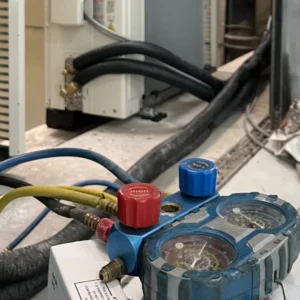
Step 6: Vacuum Testing Before the gas is released, a vacuum pump is used to remove all the air and moisture from the newly installed pipes. This step must be taken because water in the refrigerant lines makes acid, which breaks down the compressor over time. The system is shut after a pressure hold test.

Step 7: Commissioning and Test Run The service valves are opened, the gas is released into the system, and the aircon is switched on. The technician checks the operating pressure, drainage flow, and cooling output. The job is only complete when the system is blowing cold air correctly and water is draining cleanly.

Common Mistakes Homeowners Make During Aircon Relocation
Reusing old copper pipes without inspection. Copper pipes are weak after many years of temperature cycling. The exterior of the pipes may look OK, but there can be micro-cracks at the flare joints that cause slow gas leakage after moving. Any pipe that shows signs of prior corrosion, cracking or poor quality of work should be replaced rather than reused.
Hiring unlicensed contractors. Aircon relocation in Singapore must be performed by a licensed contractor. An unlicensed worker usually avoids the pump-down process entirely, venting refrigerant gas into the atmosphere and leaving you with an empty system that needs a full gas recharge before it will cool at all. Beyond legal compliance, this can be very dangerous.
Skipping the vacuum test. This is the phase that most cheap contractors skip, because it takes time. Without a rigorous vacuum and pressure test you don’t know for sure the new pipe joints are sealed. The outcome is a system that seems to be working, but slowly leaks gas until it quits cooling a few months later.
Poor indoor unit positioning at the new location. The aircon fan must be positioned to allow for proper airflow across the coil, for good drainage to the drain exit and for simple access for future servicing. If it is placed too close to a corner, too low on the wall or right above standard cabinets, it will cause performance and maintenance concerns.
Not coordinating with the ID for renovation jobs. If you are doing a full home renovation with a false ceiling, you will need to install and hide the aircon piping before the ceiling is closed up. Retrofitting concealed pipework becomes damaging and costly once the fake ceiling is installed. Once the initial fix wiring is completed, schedule your relocation professional to arrive at the proper period of the restoration, before the ceiling closes.

Why Professional Aircon Relocation Protects More Than Just Your Unit
A badly placed aircon is more than an aircon problem. “It’s a problem at home.
Gas leaks can go undetected for months, gradually degrading cooling capacity until the compressor overheats and collapses. That’s a repair bill / compressor replacement that costs a hell of a lot more than the original relocation job.
Sometimes, poor drainage alignment causes water leakage that damages ceilings, walls and floors in the room below.
Loose brackets on the exterior condenser are a safety hazard, especially for high-rise systems.
Professional relocation carried out to the suitable quality protects the equipment warranty, maintains the effectiveness of the system and ensures you are not faced with recurring callouts six months later. It also helps you stick to HDB and BCA requirements, which is important if you ever sell the house.

Frequently Asked Questions
How much does aircon relocation cost in Singapore?
Decom Aircon charges $90–$120 for a single unit relocation, $150–$200 for two units, and $250–$400 for a multi-split system of three to five units. Additional costs for extra piping, brackets, or gas top-up are quoted after a site inspection.
Is aircon relocation allowed in HDB flats?
Yes, provided the work is carried out by a licensed contractor and the outdoor condenser is placed on a designated aircon ledge or approved external bracket. HDB’s renovation guidelines must be followed. Structural modifications require a licensed contractor complying with BCA standards.
Can I reuse my old aircon piping when relocating?
Sometimes, but not always. Copper pipes in good condition with no corrosion or flare damage can be reused for shorter runs. For longer runs at the new location, new piping must be added or the entire run replaced. A technician will assess this during the site inspection.
Do I need a gas top-up after aircon relocation?
Not usually. A proper pump-down recovers the existing refrigerant into the compressor before dismantling, so you start the new installation with the same gas charge. A top-up is only needed if the new pipe run is significantly longer, or if gas levels were already low before relocation.
How long does aircon relocation take?
A single unit within the same property typically takes three to five hours. Moving two units takes half a day. A full multi-split system relocation to a new address usually takes a full working day. Your technician will give you a realistic timeline after the site inspection.
Can I move just the outdoor compressor unit without moving the indoor blower?
Yes. If you are reconfiguring your balcony or complying with new management rules about condenser placement, the outdoor unit can be relocated independently. The copper piping is extended or rerouted to the new outdoor position, and the system is pressure-tested and recommissioned.
Can my aircon be relocated during a home renovation?
Yes, and this is actually the best time to do it. Coordinating aircon relocation with your renovation means the technician can run new piping before the false ceiling closes and before carpentry is finalized. This results in a much cleaner installation with properly concealed trunking.
Why did my aircon stop cooling after being moved?
The most common causes are gas loss from an incomplete pump-down, moisture in the pipes from a skipped vacuum test, or incorrect pipe flaring at the connection joints. If your aircon was relocated by another contractor and is not performing correctly, book a diagnostic check to identify the specific cause before the issue causes compressor damage.
Can I move my aircon to a completely new address?
Yes. We handle both within-property relocations and full moves to a new address. The process is the same: pump-down, dismantling, transport, reinstallation, pressure test, and commissioning. The only difference is the transport logistics for the outdoor condenser, which we manage carefully.
Do I need condo management approval before relocating my aircon?
Most condominiums require you to notify or obtain written approval from the MCST before any aircon works begin, particularly if the outdoor condenser placement is changing. Check with your managing agent before booking. We can work within your approved contractor requirements.
How do I know if my aircon is worth relocating or if I should just buy a new unit?
If your unit is under eight years old and in working condition, relocation usually makes financial sense. At $90–$400 for a professional relocation, it is significantly cheaper than a replacement system. If the unit is older than ten years, has had repeated compressor issues, or uses the legacy R22 refrigerant (phased out), a new installation may deliver better long-term value. We can advise you honestly after seeing your setup.
What is the difference between aircon relocation and aircon installation?
Relocation means moving an existing unit you already own. Installation refers to setting up a brand new unit. Relocation costs are lower because you are not purchasing new equipment, but the technical steps are similar in scope: piping, brackets, gas handling, vacuum testing, and commissioning.
Can aircon be relocated to a different floor of the same house?
Yes, but a different-floor relocation requires a longer pipe run (often through walls or chases between floors) and more complex drainage routing. The cost will be higher than a same-floor move. Send us photos of your current setup and intended new location for an accurate assessment.

Book Your Aircon Relocation in Singapore
The fastest way to get an accurate quote is to WhatsApp us a few photos your current indoor unit location, the outdoor compressor, and the intended new position. We will review the setup, confirm the scope of work, and give you a transparent price with no hidden add-ons.
All Decom Aircon relocation jobs include proper gas pump-down, pressure testing, fresh piping where needed, and a final test run before we leave. We do not take shortcuts and we do not reuse old materials that will fail later.
Book your aircon relocation or send us a WhatsApp to start with a fast quote.
If you are planning a full renovation and want to understand the broader scope of aircon work involved including new installation for a BTO or resale flat view our aircon and BTO installation packages.