

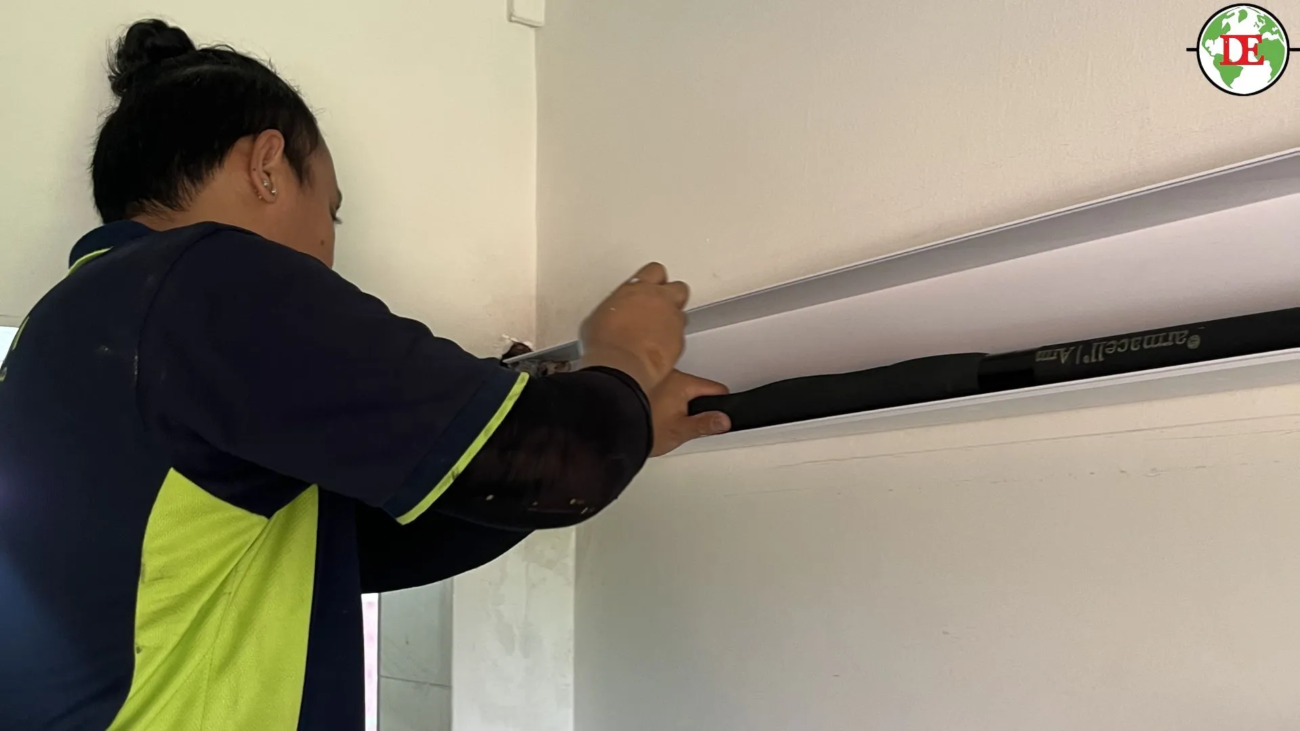
Decom Aircon has over 25 years of installs all across Singapore and BCA verification on our workmanship. We will provide you with a pipe route plan before anything is drilled. Whether you are contemplating an installation or upgrading an existing system, talk to us first.
Most homeowners spend weeks comparing aircon manufacturers, BTU values and energy tick scores. Then on install day they look at the pipes running over the wall, and say “yeah that’s fine”.
Six months later there’s a wet stain on the bedroom door with no visible reason.
Aircon trunking is one of those little decisions that don’t seem like much at the time but play out over the full life of your system. Hit the correct note and your aircon works efficiently, looks attractive and is easy to maintain for a decade. Get it incorrectly and you’ll be dealing with condensation dripping, difficult to access blocked drainage or a partial breakdown during your next renovation.
Here’s a guide that covers all you need to know before making that call, whether you are calling from a HDB resale flat, a new BTO, a condo or a landed property.
What Is Aircon Trunking?
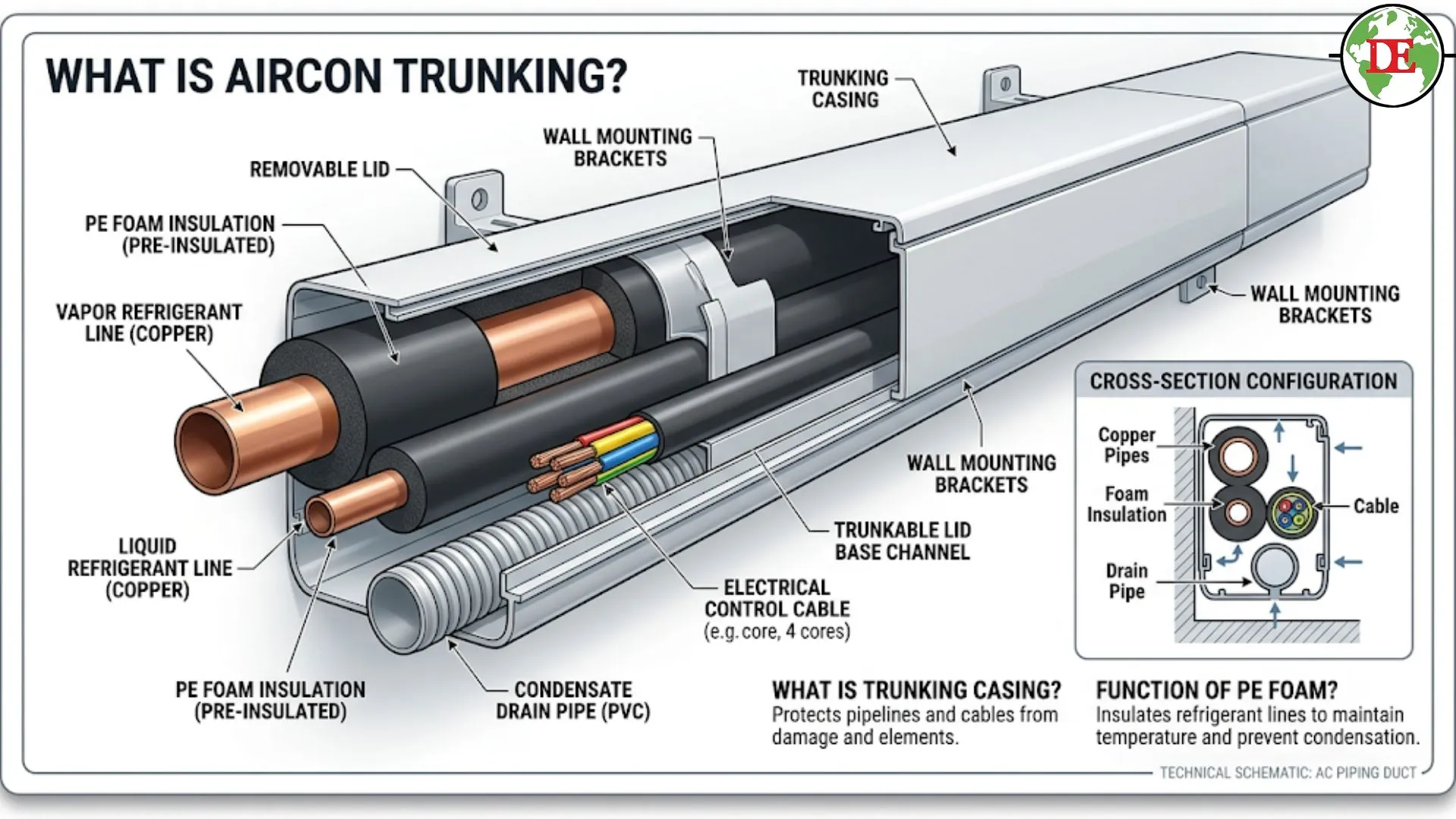
Aircon trunking The protective casing that extends from your indoor fan coil unit to the outside condenser unit. It binds four key components together and shields them:
- Copper refrigerant pipes (Typically 1/4″ liquid line and 3/8″ or 1/2″ suction line for single-split systems; bigger for System 3 and System 4 configurations)
- Electrical cable linking the indoor and outdoor units
- Drainage pipe carrying condensate water out of the space
- PE foam insulation wrapped around the copper pipes to prevent sweating and heat gain
The trunking does nothing to cool the air. But it influences whether those 4 components stay protected, if condensate water drains properly, and whether a professional can actually get to what needs service 5 years from now without chopping open your wall.
Bottom line: Trunking is not a cosmetic wrap. It is the structural home for four important components. Its routing and installation impact cooling effectiveness, risk of water leakage and long-term maintenance access.
Why Aircon Trunking Matters More Than You Think
Cooling Efficiency
Extra strain is put on the compressor by poorly insulated or kinked copper tubing. Long pipe runs are less efficient notably in the case of multi-splits System 3 and System 4 when refrigerant has to travel more distance. Every needless pipe run metre is a modest but cumulative performance penalty.
Water Drainage
Your coolant drain pipe within your trunking must have a continuous fall of at least 1cm every metre of run. That’s a 1:100 gradient at the least. Installers who neglect this create flat or reverse-sloped portions that trap water. Algae has grown thick, the line is clogged, water is pouring from the drainage tray into the room below.
Many of the aircon leaking water calls we respond to are not because of a broken unit. They are created by a drain pipe that was never properly sloped when first installed.
Future Servicing Access
The professional will require clear access to the fan coil unit, the drainage tray and the pipe connections if your system needs an aircon gas top up or hydro cleaning. Trunking that covers everything tightly or passes via concealed ceiling cavities without inspection panels makes simple maintenance a major task.
Protection from Singapore’s Climate
Singapore’s heat and humidity are brutal. PE foam insulation that is directly exposed to UV light will deteriorate in 2-3 years. Poorly insulated copper pipes often sweat significantly . This saturates surrounding materials and creates perfect conditions for mould growth inside walls and ceilings.
Aesthetic Impact
The way your trunking runs up walls and ceilings is a big part of how the space feels. Trunking close to eye level, twisting at acute angles without coverings, or crossing door frames needlessly suggests a hurried installation. And that’s important for liveability and it’s important at resale.
Types of Aircon Trunking Used in Singapore
Standard PVC Trunking (Exposed / Surface-Mounted)
Most home installations in Singapore use PVC trunking as the standard. Standard diameters are 25x16mm for single pipe runs, 38x25mm or 50x38mm for System 3 and System 4 configurations where many pipe bundles follow the same route. The bigger your system the wider your casing needs to be .
Works well because:
- Faster installation, lower price
- Full access for future service and repairs
- No wall hacking or carpentry involved
- Individual pieces can be easily replaced if damaged
Limitations:
- Can be seen on ceilings and walls
- Routing options made at installation have a strong impact on appearance quality.
- Large multi-room systems can make thick pipe bundles look big
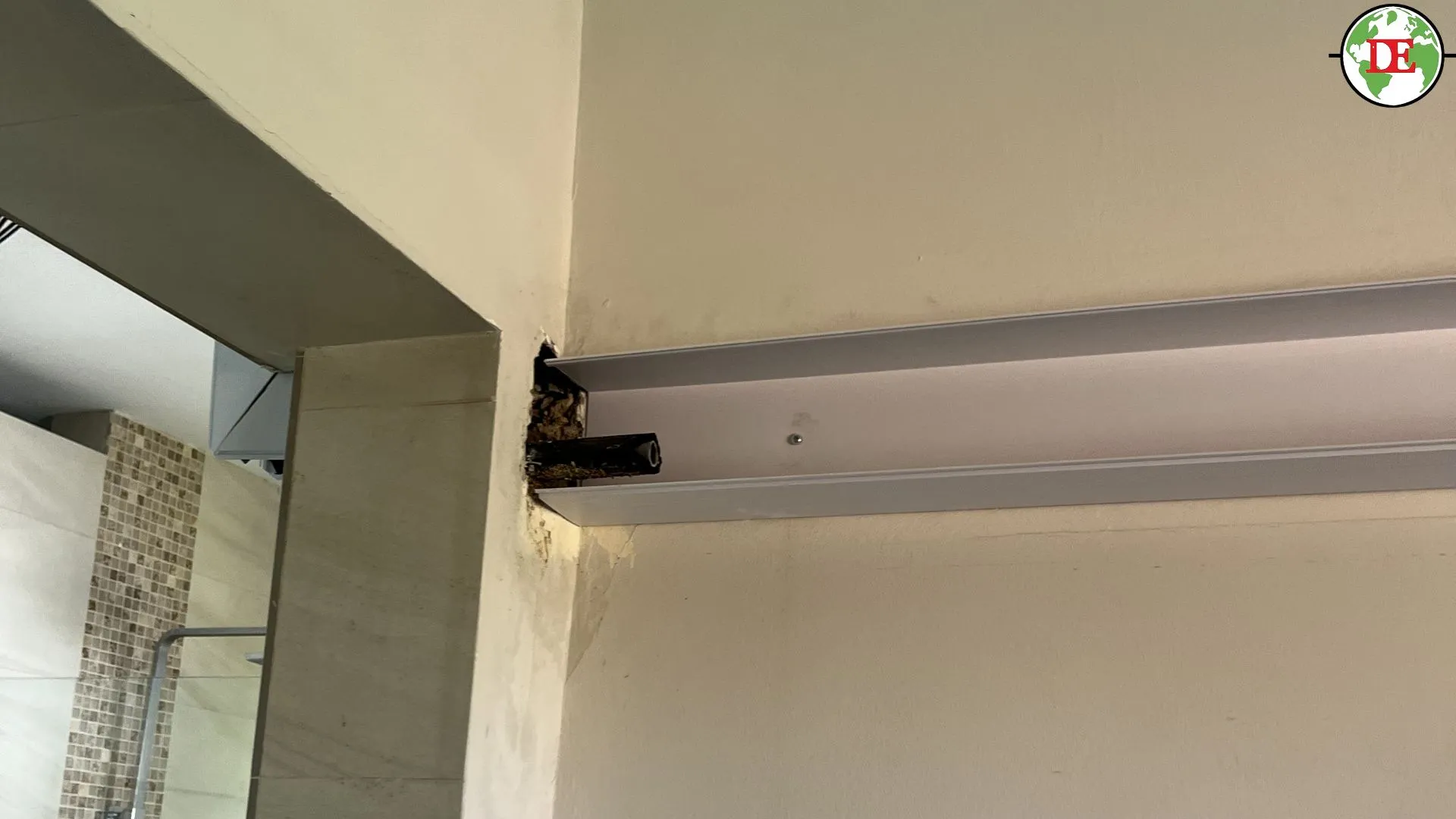
Best for: HDB resale flats Tenanted flats Landlords who value utility Anyone who wants maintenance to be easy and economical in the long run.
Concealed Aircon Trunking
Concealed trunking hides the pipe bundle behind artificial ceilings, partition walls or custom woodwork. The pipes still run in a protected conduit but nothing of it can be seen from the living room.
Works well because:
- Sleek interior design, no visible pipes or casing
- Works perfectly with trendy renovation styles
- Preferred for upscale condos and landed houses
- Enhances the perceived worth of the space
Limitations:
- Expensive (Need to make an artificial ceiling or hack)
- Drainage problems are more difficult to diagnose and access.
- Pipe connections require access via the ceiling or wall for inspection
- Not usually possible in HDB flats where false ceiling depth is limited by ceiling height/layout
Best for: BTO flats fully renovated. Condominiums. Landed properties with the drainage plan and maintenance access designed in from the start.
Expert Tip: HDB flats cannot be hacked into structural walls. Concealment is by fake ceiling or feature wall carpentry installed during reconstruction. Call any aircon contractor. But check with your interior designer.
External Wall Trunking
Some installations run trunking on exterior walls, usually in older HDB blocks, business flats or properties with restricted internal routing options. Not as prevalent in residential installs today.
Works well because:
- Removes pipes from interior spaces
- Easier to route in some building floor plans
Limitations:
- exposed to rain and sun which increases the decomposition of material
- Needs UV resistant trunking to last any acceptable length of time
- Problematic aesthetics in most household contexts
Best for: Commercial installations, older structures, or if internal routing is truly not possible.
Concealed vs Exposed Trunking: Full Comparison
| Factor | Exposed PVC Trunking | Concealed Trunking |
| Appearance | Visible on walls and ceilings | Fully hidden |
| Installation Cost | Lower | Higher (false ceiling or hacking required) |
| Installation Time | 1 to 3 hours | Several days, renovation dependent |
| Maintenance Access | Easy | Difficult; may require opening ceiling |
| Leak Detection | Visible quickly | Often found late |
| Suitable for HDB | Yes, most layouts | Limited; false ceiling required |
| Suitable for BTO | Yes | Yes, if planned before wet works |
| Suitable for Condo | Yes | Yes, preferred |
| Suitable for Landed | Yes | Yes, ideal |
| Renovation Required | No | Yes |
| Pipe Replacement | Straightforward | Complex; may require hacking |
| Long-Term Practicality | High | Medium, depends on access planning |
Open PVC trunking is the practical solution for HDB apartments and leased properties.For BTO owners going through major renovations, and for condo or landed homeowners, concealed trunking is well worth the expense when drainage and access are properly constructed in the first place.
Most contractors won’t tell you this, but here it is: hidden trunking that traps the drainage pipe inside an inaccessible ceiling cavity is not an improvement. It’s a liability just waiting to rear its ugly head at the worst possible time. That is a decision that your renovation contractor and your aircon professional should make together, not separately.
What Homeowners Need To Know: The choice between concealed and open trunking is not purely a matter of aesthetics. It’s about being able to service and access the system over the next 10 to 15 years without a renovation. Design the access before you build anything.
Aircon Trunking for BTO Flats
Advantage to BTO owners: an empty canvas. That also implies the errors you make in the refurbishment are set for the life of the flat.
Timing is everything. During wet works you have to complete your trunking path before the false ceiling panels are put in. Once the ceiling is closed, any change in routing means you have to open it back up.
False ceiling planning. Many BTO owners will do artificial ceilings for the living room and master bedroom. If such is your goal, check the following with your aircon contractor before your ID goes ahead:
- Where should the fan coil unit be located?
- Does the drain pipe come out at a downward angle? Does that angle lead down to the outside wall?
- Is there an access panel located above the indoor unit for service in the future?
One of the most typical renovation faults we notice in BTO units is a fake ceiling without a maintenance access panel above the fan coil unit. When the first significant service or aircon repair is needed, the technician needs to break the ceiling to access the drain connection.
System 3 and System 4 pipe bundles. A System 3 installation is made up of three runs of copper piping, electrical wiring and condensate drain piping all coming from the condenser. The bundle is heavy. Size the trunking or ceiling cavity for the actual installation, not for a single-split equivalent.
Feature walls and carpentry. If your ID is putting a TV feature wall or closet on top of the pipe route, ensure the internal dimensions will fit the pipe bundle without compressing the insulation. The insulation is compressed which causes condensation which causes water damage inside the carpentry.
If you are looking for a BTO installation and want the trunking route to be checked before remodeling begins, please see our BTO Aircon Installation Packages.
Common Aircon Trunking Mistakes
Having done installs in HDB blocks, BTO apartments, condominiums and landed properties all throughout Singapore for more than 25 years, some mistakes seem to be recurring. Here’s what to look for.
Poor Pipe Routing
Cause: Routing pipes along the quickest path without regard to clearances, aesthetics or access.
Result: Trunking that is below eye level, crosses door frames unnecessarily, bends at severe angles, or runs through regions where it will be bumped on a frequent basis; Sharp curves hinder refrigerant flow and reduce system efficiency.
Prevention: A good contractor walks the projected route with you before the first clip is in the wall. The shortest method is not always the best option. It’s the one that looks right, drains well, stays available throughout the life of the system.
Incorrect Drainage Slope
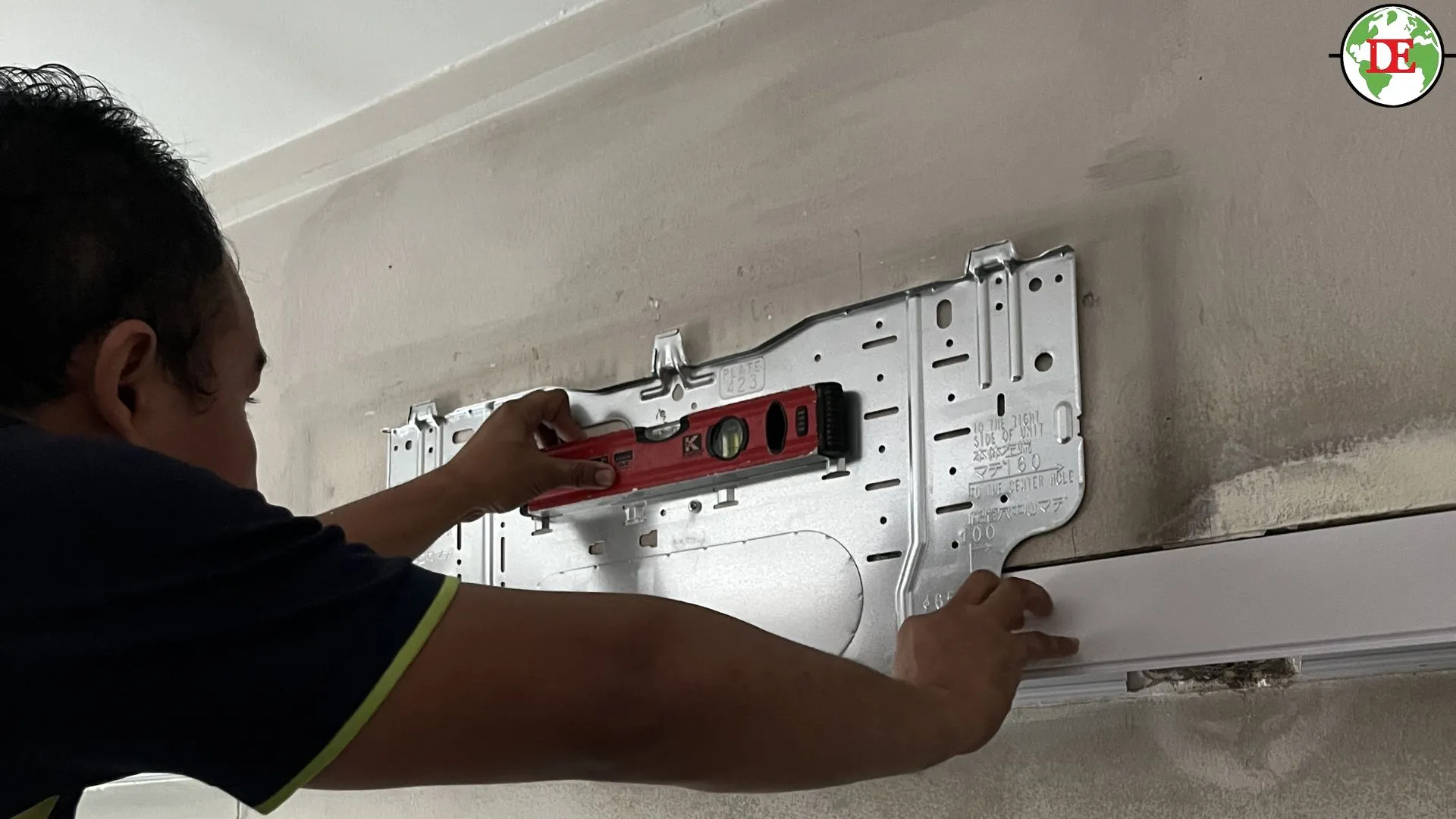
Cause: The condensate drain pipe is laid flat or in parts with an upward slope.
Result: A pool of water. Biofilm growth. The line is blocked. Water leaks from the drainage tray into the room. Many calls we receive for aircon leaking water are simply this, not a damaged unit, just a drain pipe that was never levelled.
Prevention: Each segment of drain pipe must have a minimum of 1:100 gradient. One centimeter drop every meter horizontal run. This needs to be checked by the standard spirit level at the time of installation not by eye.
Compressed or Low-Quality Insulation
Cause: Using PE foam that is too small, or squeezing it into trunking casing that is too narrow.
Result: The suction pipe is sweating. The condensation builds on the surface of the copper pipe and soaks up the insulation and drops within the trunking. That moisture will go to the lowest point and form water stains on walls or ceilings, frequently far away from the actual water entry point.
Prevention: Insulate with insulation appropriate for the pipe diameter. Do not compact insulation before installing it . The casing has to be big enough to fit all pipes, cables, drain pipe and insulation without anything being crushed.
Pipe Runs That Exceed Manufacturer Limits
Cause: Too far apart indoors and outdoors Often a decision that is made after the layout of the renovation is already set.
Result: All aircon manufacturers provide maximum permitted pipe run lengths and maximum allowable height differences between indoor and outside units. Cross these restrictions and you are looking at lower cooling efficiency, more strain on the compressor and in certain cases invalidated warranty.
Prevention: Plan for condenser placement during renovation not after. Our team reviews the manufacturer standards for each system before we agree on any pipe path. We catch it before the layout is installed, not later. If the suggested layout is out of limits we flag it.
No Maintenance Access in Concealed Installations
Cause: Concealing all trunking without leaving any inspection or service access.
Result: When the drain line blocks or a technician needs to inspect pipe connections, the only option is to open the false ceiling or hack a wall. A routine air conditioning service job becomes a partial renovation.
Prevention: Any section of concealed trunking running through a false ceiling must have an access panel above the drain connection and near the main pipe junction points. This is non-negotiable if you want to avoid expensive rework later.
Signs Your Existing Aircon Trunking Needs Replacement
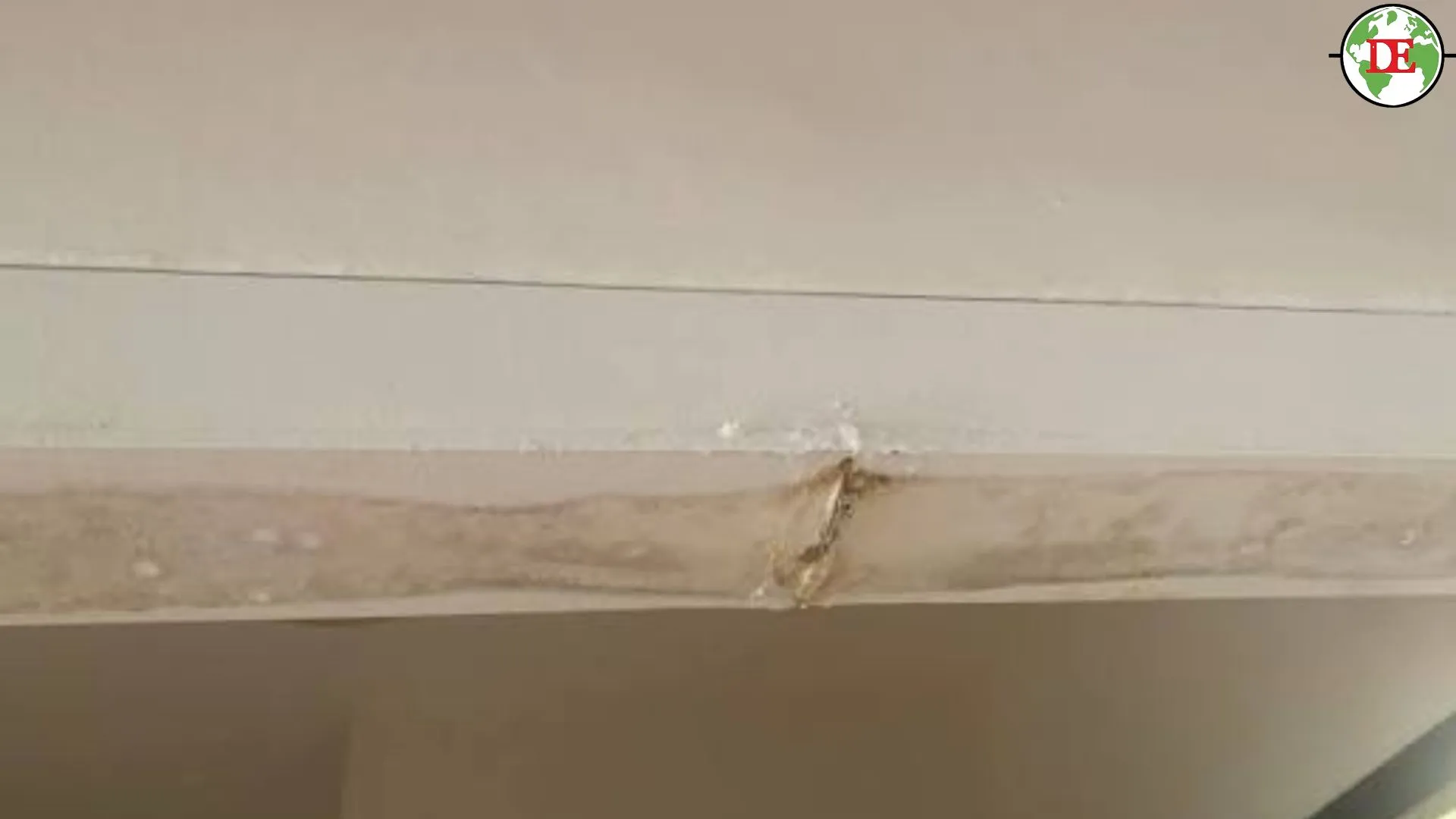
Some of the trunking concerns are not evident from the outside. This is the signs that something needs to be dealt with:
- Cracks or cracking in the PVC casing, especially around the joints and corners
- Condensation on the outside of the trunking (failure of internal insulation)
- Yellowish or brown stains on walls below the pipe run
- Visible PE foam where the shell has split or detached
- Mould growing on the borders of trunking or the wall right behind it
- Soft or degraded foam on pressing the trunking
- Rust stain at the drain pipe exit point.
In most cases, it makes sense to modify trunking as well as put in a new system. Replacing trunking on a functional aircon system is never cost effective unless there is ongoing water damage or a structural collapse in the casing.
How Long Does Aircon Trunking Last?
Quality PVC trunking, when placed correctly in a protected interior environment, should last 10 to 15 years. If trunking is installed on outside walls or in direct sunlight, it could show considerable degeneration in 5-7 years.
What actually determines how long it holds up:
Quality of installation. Trunking fitted with the right spacing of clips, sealed joints and tight corners will last a lot longer than work done in a hurry. Moisture ingress can occur at gaps at joints.
Grade of Material. Standard PVC Wall Thicknesses UV Resistance Different Fire-rated thicker-wall PVC. Cheaper alternatives fail in the long run.
UV exposure. Direct sun is the quickest way to age any trunking material. Even indirect exposure on a west-facing wall speeds disintegration.
Servicing regularity. Routine aircon hydro wash identifies drain obstruction before it saturates insulation and damages trunking from within. This is not without relevance to trunking existence. It is wired in.
Pipe insulation integrity. Once the PE foam on the suction pipe starts failing, the resulting condensation attacks the trunking from the inside. By the time you see a water mark on the wall, the damage inside may already be extensive.
For most home owners, trunking replacement happens at the same time as an aircon system upgrade, usually every 10 to 12 years. If you’re purchasing a resale flat that is more than 10 years old, don’t assume that the trunking is serviceable, have it checked out..
How to Choose the Right Aircon Contractor
The trunking is only as good as the installer. Beyond the brand of unit being sold, here is what to evaluate:
Experience with your property type. An installer who has done hundreds of BTO flat jobs plans trunking differently from someone who primarily handles commercial units. Ask directly about their experience with your property category.
Drainage planning process. Ask specifically: “How do you verify the drainage slope is correct?” An experienced installer will describe their process. If the answer is vague, that tells you something.
Pre-installation pipe route walkthrough. Before a single clip is drilled, a good contractor should walk you through the proposed trunking route. You should know exactly where the casing will run on every surface before work begins.
Material transparency. Ask what grade of PVC trunking and what thickness of PE foam insulation they use. Any experienced, legitimate contractor will answer this directly without hesitation.
BCA verification. Decom Aircon is BCA (Building and Construction Authority) verified. This means our installation and workmanship standards meet regulatory requirements, which matters for warranty documentation and resale.
Workmanship warranty. Confirm what the installation warranty covers. Drainage slope, insulation integrity, and trunking quality should be included, not excluded.
For a full Aircon Installation Singapore service that includes detailed trunking planning across all property types, our team handles everything from the initial route assessment to drainage verification after installation.
Conclusion
You don’t leave aircon trunking completely to whoever turns up on the day. Your decisions about routing, drainage, insulation, aircon relocation and access will determine the performance of your system and your maintenance costs for the next 10 to 15 years.
Frequently Asked Questions
What is aircon trunking?
Aircon trunking is the protective casing that holds the copper refrigerant pipes, electrical cable, condensate drainage pipe and PE foam insulation for your system. It travels from the inside fan coil unit to the outdoor condenser, safeguarding these components from physical harm, UV exposure and moisture, and keeping the installation neat and tidy.
Is concealed aircon trunking better than exposed trunking?
Not always. Hidden trunking appears neater, but if the slope of the drainage is improper or there are no access panels, it poses more difficulties than open trunking ever would. And for most HDB flats, exposed PVC trunking is the most practical option. Concealed trunking is a great solution for BTO renovations, condos and landed properties if designed from the start.
Can aircon trunking be hidden after renovation is complete?
It is possible but costly. After renovation, hiding trunking usually involves exposing artificial ceilings, creating new furniture, or, in some situations, hacking. In HDB flats, hacking structural walls is impossible, therefore hiding relies on fake ceilings or feature walls. “Planning for this is best done before the wet works start not after the renovation is complete.
How long does aircon trunking last?
In protected interior settings, a good quality PVC trunking will normally last 10 to 15 years. over a period of 5 to 7 years, external or UV-exposed trunking may deteriorate. Actual lifespan depends on quality of installation, grade of material, UV exposure and frequency of servicing of the aircon system.
Does poor trunking cause water leakage?
Yes. The most common trunking-related cause of water leakage is an incorrect drainage slope. When the condensate drain pipe runs flat or slopes upward in sections, water pools, biofilm builds up, and eventually the line blocks and overflows. Failed pipe insulation that allows condensation to form inside the casing is another common cause.
What trunking setup is best for BTO flats?
For BTO owners doing a full renovation with false ceilings, concealed trunking is worth the investment if planned early, before wet works. For BTO owners on tighter budgets or without false ceiling plans, well-installed exposed PVC trunking with correct drainage slope delivers strong long-term performance.
Can old trunking be reused when upgrading the aircon?
It depends on the condition. If the existing trunking is more than 10 years old, has cracks, or has compressed insulation, reusing it risks creating leaks and drainage problems on a brand-new system. Have a qualified technician inspect the existing trunking before deciding. Do not assume age equals failure, but do not assume it is fine either.
When should aircon trunking be replaced?
Replace trunking when you see cracks in the casing, condensation forming on the trunking exterior, water stains on walls below the pipe run, exposed or deteriorated foam insulation, or mould growth along the edges. Also replace it when upgrading to a new aircon system if the existing trunking is more than 10 years old.